Let me start with something honest.
When Japandi first started appearing on design blogs a few years ago, I dismissed it. It looked like minimalism with a better PR team. White walls, one plant, a low wooden bed frame, and someone calling it a lifestyle. I’ve seen trends come and go and this felt like another one that would age badly and get replaced by the next thing six months later.
I was wrong.
In 2026, Japandi isn’t just surviving — it’s the dominant residential design aesthetic among people who are thinking seriously about how their homes feel to live in, not just how they look in photos. And the reason it has lasted is the same reason I underestimated it at first. It isn’t really about aesthetics. It’s about philosophy.
What Japandi Interior Design Actually Is
The word is a mashup of Japan and Scandi. But understanding what it means requires understanding where both traditions come from.
Japanese design is rooted in wabi-sabi — a concept that finds beauty in imperfection, impermanence, and incompleteness. The hand-thrown ceramic that’s slightly uneven. The wooden surface that shows its grain. The worn textile that’s softer for having been used. Wabi-sabi is the opposite of showroom-perfect. It’s the beauty that develops through time and use rather than despite it.
Scandinavian design brings something different. Hygge — a Danish and Norwegian concept that translates roughly as cozy contentment — prioritizes the warmth of a space over its visual precision. Soft light. Tactile materials. The sense that a room is genuinely comfortable rather than just composed.
Put those two together and you get something interesting. Japanese restraint stops Scandinavian warmth from becoming clutter. Scandinavian warmth stops Japanese minimalism from feeling cold. The result is spaces that are edited but not empty. Simple but not stark. Natural but not rustic.
That balance is harder to achieve than it sounds. Most interiors fall to one side or the other — either too sparse and hospital-like, or warm but visually busy. Japandi sits in the exact middle, and that’s why it’s so hard to get tired of.
How It’s Changed in 2026
The Japandi that’s showing up in real homes in 2026 looks different from the version that launched the trend a few years back.
The early version was very pale. Blonde wood, white walls, linen in oat and cream. Beautiful in photographs, slightly underwhelming in person — a lot of people tried it, found it felt washed out, and moved on.
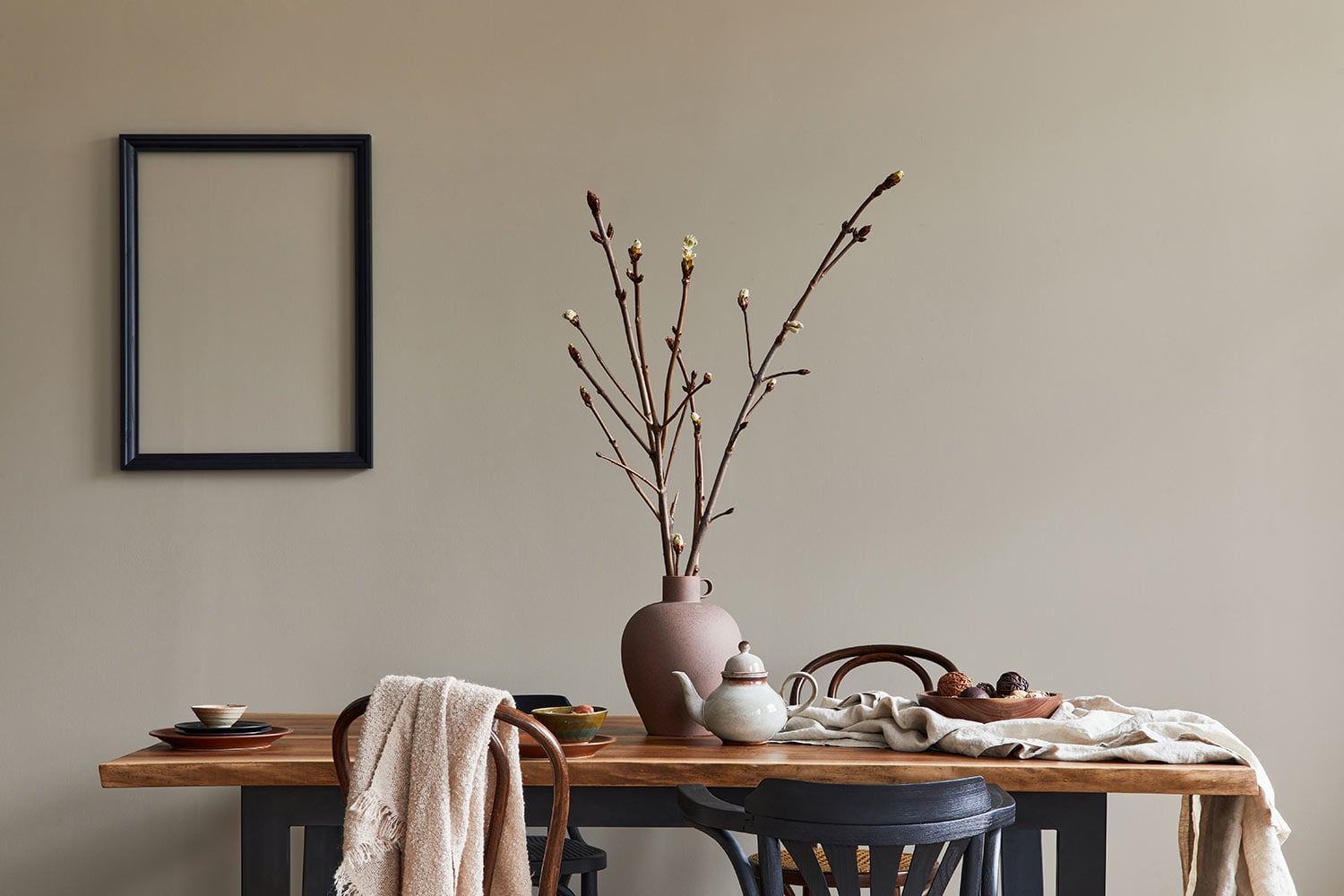
What’s replaced it is richer and moodier. Dark Japandi is the phrase designers are using. Walnut and espresso wood tones instead of blonde oak. Charcoal and deep rust alongside the neutral palette. Walls in warm clay tones rather than pure white. Burnt wood — the Japanese Shou Sugi Ban technique of charring timber to preserve and darken it — showing up on everything from furniture legs to wall cladding.
The principle stays the same. Natural materials, clean lines, nothing that doesn’t earn its place. But the colour story got a lot more interesting.
The other significant shift is scale. Where early Japandi used small gestures — a single stem in a ceramic vase, a neat row of objects — current Japandi is thinking bigger. Large indoor trees in substantial pots rather than small succulents on a shelf. Statement lighting fixtures that anchor a room rather than disappear into it. Rugs with real presence rather than polite understatement.
Both shifts move in the same direction — toward spaces that feel genuinely inhabited rather than staged.
The Room-by-Room Reality
Here’s where most guides go wrong. They show you the ideal version and leave you to figure out how to get there from wherever you actually are.
The Living Room
This is where most people start because it’s the most public room and the one with the most potential impact.
The single most effective Japandi move in a living room isn’t buying anything new. It’s removing things. Clear every surface down to almost nothing. Take everything off the shelves, off the coffee table, off the sideboards. Then only put back what you’d genuinely miss if it weren’t there.
What comes back should be honest. A book you’re actually reading. A ceramic piece that means something. One plant that you actually care for rather than three that are slowly dying. The things that have a reason to be there rather than things that accumulated over time.
Then address the furniture. Low-profile seating in natural fabric — linen, wool, cotton — in a warm neutral. A coffee table in real wood. Nothing that looks like it came from a flat-pack catalogue designed to disappear.
The Bedroom
The goal here is restfulness. That sounds obvious but most bedrooms are fighting themselves — half decoration, half function, neither fully achieved.
In Japandi, the bed is the clear anchor. Everything else serves it. Bedside tables at the right height, in real wood, with space for exactly what you actually use at night — not a crowded surface of things you moved there and forgot. Lighting warm and positioned at eye level or below, never harsh overhead. Storage discreet and closed, so the visual noise of belongings doesn’t interrupt the calm.
The textile layer is where Japandi bedrooms do their best work. Natural linen or cotton in muted warm tones — not stark white, not heavily patterned — layered with a wool or cotton throw. The physical quality matters as much as the colour. Rough-textured linen reads differently from silky-smooth cotton even in the same colour. Japandi wants the former.
For quality natural linen and cotton bedding in earthy warm tones that sit perfectly in a Japandi bedroom, Adairs has a strong range of bed linen — particularly their Vintage Wash Linen collection, which has the natural texture and muted palette that Japandi needs and which genuinely improves with each wash.
The Kitchen
Clean cabinetry in natural wood or a muted painted tone. Concealed storage wherever possible — the inside of a Japandi kitchen can be as chaotic as any other kitchen, but the surfaces and fronts are calm. One or two functional objects on the counter that are also beautiful — a wooden chopping board, a ceramic vessel, a good knife block — rather than appliances and gadgets competing for attention.
Counter materials in stone or concrete where possible. Not because it’s trendy but because natural materials age in a way that engineered surfaces don’t.
The Entryway
Often ignored and extremely high impact. The entryway sets the register for the entire home. One good hook system for coats. A single low bench or shelf for shoes with proper storage underneath. A plant if you have natural light. That’s all a Japandi entryway needs — and that restraint is what makes it feel intentional rather than just tidy.
What to Actually Buy
Every design guide eventually becomes a shopping guide, so let’s be direct about this.
The investments that make the most difference in a Japandi space are almost never the headline furniture pieces. They’re the smaller things that the eye lands on repeatedly — the materials and textures that accumulate into an atmosphere.
Real wood over anything that imitates it. Not necessarily expensive — a solid timber side table from a local maker often costs less than a mass-market alternative once you factor in how long it will last.
Natural textiles over synthetic ones. Linen, cotton, wool. The difference in how they feel and how they age is significant.
Lighting that positions itself at human level. A floor lamp, a table lamp, a pendant hung low. Not overhead downlights that flatten a room and make everyone look tired.
Handmade ceramics over mass-produced decorative objects. One piece that someone made with their hands does more for a Japandi space than ten objects from a homewares chain. Australian potters and ceramicists are producing genuinely beautiful work at accessible price points — worth seeking out specifically rather than defaulting to what’s available at a retail chain.
For broader home styling inspiration, room-by-room decorating approaches, and practical guides to making design decisions that actually work in real Australian homes, HomeCrafted.co covers home design and DIY with the kind of grounded, practical focus that Japandi itself embodies.
The Mistake Most People Make
They try to do it all at once.
One weekend, everything changes. New bed linen, new cushions, half the furniture moved to another room, decorative objects from three different stores. The result usually looks like an attempt at Japandi rather than the actual thing — because Japandi requires editing over time, not transformation in a weekend.
The spaces that get Japandi right have been lived in, adjusted, refined. Things were removed that felt wrong. Objects were found slowly rather than purchased quickly. The palette emerged from deliberate choices made over months rather than a single shopping expedition.
Start with one room. Start with removing rather than adding. Live with the emptier version for a few weeks before deciding what comes back. That process — the slow, considered editing — is itself a Japandi practice.
Why It Lasts
Most design trends solve a visual problem. Japandi solves a felt problem.
The visual problem it addresses is real — mass-produced interiors that look the same everywhere, too much stuff, no clear sense of what a space is for. But the deeper thing it addresses is how a room makes you feel when you walk into it after a long day. Whether it quiets you or continues the noise.
That’s not a problem that goes out of fashion. People wanted homes that felt calm and deliberate in 2022 and they want it more urgently in 2026. Japandi answers that want more reliably than almost any other current design direction.
It isn’t perfect and it isn’t for everyone. If you love a maximalist space full of colour and collected objects, Japandi will feel like deprivation rather than relief.
But if you’ve ever walked into a well-designed room and felt something physically relax in you — the kind of space that asks nothing of you and gives you quiet in return — then you already understand what Japandi is trying to do.
The only question is how much of it you want in your own home.